


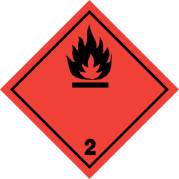
FUEL CELL CARTRIDGES or FUEL CELL CARTRIDGES CONTAINED IN EQUIPMENT or FUEL CELL CARTRIDGES PACKED WITH EQUIPMENT, containing hydrogen in metal hydride
ADR 2025 · Class 2 · carriage of dangerous goods by road
- Class
- 2
- Classif.
- 6F
- Hazard labels
- 2.1
- Transport cat.
- 2 (D)
- Class
- 2
- Classification code
- 6F
- Hazard labels
- 2.1
- Limited quantities
- 120 ml
- Excepted quantities
- E0
- Packing instructions
- P004
- Exemption limit
- 333 kg/L
Special provisions
SP 328
This entry applies to fuel cell cartridges including when contained in equipment or packed with equipment. Fuel cell cartridges installed in or integral to a fuel cell system are regarded as contained in equipment. Fuel cell cartridge means an article that stores fuel for discharge into the fuel cell through (a) valve(s) that control(s) the discharge of fuel into the fuel cell. Fuel cell cartridges, including when contained in equipment, shall be designed and constructed to prevent fuel leakage under normal conditions of carriage. Fuel cell cartridge design types using liquids as fuels shall pass an internal pressure test at a pressure of 100 kPa (gauge) without leakage. Except for fuel cell cartridges containing hydrogen in metal hydride which shall be in compliance with special provision 339, each fuel cell cartridge design type shall be shown to pass a 1.2 meter drop test onto an unyielding surface in the orientation most likely to result in failure of the containment system with no loss of contents. When lithium metal, lithium ion or sodium ion batteries are contained in the fuel cell system, the consignment shall be consigned under this entry and under the appropriate entries for UN No. 3091 LITHIUM METAL BATTERIES CONTAINED IN EQUIPMENT, UN No. 3481 LITHIUM ION BATTERIES CONTAINED IN EQUIPMENT or UN No. 3552 SODIUM ION BATTERIES CONTAINED IN EQUIPMENT.
SP 339
Fuel cell cartridges containing hydrogen in a metal hydride carried under this entry shall have a water capacity less than or equal to 120 ml. The pressure in the fuel cell cartridge shall not exceed 5 MPa at 55 °C. The design type shall withstand, without leaking or bursting, a pressure of twice the design pressure of the cartridge at 55 °C or 200 kPa more than the design pressure of the cartridge at 55 °C, whichever is greater. The pressure at which this test is conducted is referred to in the drop test and the hydrogen cycling test as the "minimum shell burst pressure". Fuel cell cartridges shall be filled in accordance with procedures provided by the manufacturer. The manufacturer shall provide the following information with each fuel cell cartridge: (a) Inspection procedures to be carried out before initial filling and before refilling of the fuel cell cartridge; (b) Safety precautions and potential hazards to be aware of; (c) Method for determining when the rated capacity has been achieved; (d) Minimum and maximum pressure range; (e) Minimum and maximum temperature range; and (f) Any other requirements to be met for initial filling and refilling including the type of equipment to be used for initial filling and refilling. The fuel cell cartridges shall be designed and constructed to prevent fuel leakage under normal conditions of carriage. Each cartridge design type, including cartridges integral to a fuel cell, shall be subjected to and shall pass the following tests: Drop test A 1.8 metre drop test onto an unyielding surface in four different orientations: (a) Vertically, on the end containing the shutoff valve assembly; (b) Vertically, on the end opposite to the shutoff valve assembly; (c) Horizontally, onto a steel apex with a diameter of 38 mm, with the steel apex in the upward position; and (d) At a 45° angle on the end containing the shutoff valve assembly. There shall be no leakage, determined by using a soap bubble solution or other equivalent means on all possible leak locations, when the cartridge is charged to its rated charging pressure. The fuel cell cartridge shall then be hydrostatically pressurized to destruction. The recorded burst pressure shall exceed 85 % of the minimum shell burst pressure. Fire test A fuel cell cartridge filled to rated capacity with hydrogen shall be subjected to a fire engulfment test. The cartridge design, which may include a vent feature integral to it, is deemed to have passed the fire test if: (a) The internal pressure vents to zero gauge pressure without rupture of the cartridge; or (b) The cartridge withstands the fire for a minimum of 20 minutes without rupture. Hydrogen cycling test This test is intended to ensure that a fuel cell cartridge design stress limits are not exceeded during use. The fuel cell cartridge shall be cycled from not more than 5 % rated hydrogen capacity to not less than 95 % rated hydrogen capacity and back to not more than 5 % rated hydrogen capacity. The rated charging pressure shall be used for charging and temperatures shall be held within the operating temperature range. The cycling shall be continued for at least 100 cycles. Following the cycling test, the fuel cell cartridge shall be charged and the water volume displaced by the cartridge shall be measured. The cartridge design is deemed to have passed the hydrogen cycling test if the water volume displaced by the cycled cartridge does not exceed the water volume displaced by an uncycled cartridge charged to 95 % rated capacity and pressurized to 75 % of its minimum shell burst pressure. Production leak test Each fuel cell cartridge shall be tested for leaks at 15 °C ± 5 °C, while pressurized to its rated charging pressure. There shall be no leakage, determined by using a soap bubble solution or other equivalent means on all possible leak locations. Each fuel cell cartridge shall be permanently marked with the following information: (a) The rated charging pressure in MPa; (b) The manufacturer's serial number of the fuel cell cartridges or unique identification number; and (c) The date of expiry based on the maximum service life (year in four digits; month in two digits).