


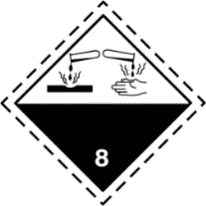
BATTERIES, WET, NON- SPILLABLE, electric storage
ADR 2025 · Class 8 · carriage of dangerous goods by road
- Class
- 8
- Classif.
- C11
- Hazard labels
- 8
- Transport cat.
- 3 (E)
- Class
- 8
- Classification code
- C11
- Hazard labels
- 8
- Limited quantities
- 1 L
- Excepted quantities
- E0
- Special packing
- PP16
- Hazard number
- 80
- Exemption limit
- 1000 kg/L
Special provisions
SP 238
(a) Batteries can be considered as nonspillable provided that they are capable of withstanding the vibration and pressure differential tests given below, without leakage of battery fluid. Vibration test: The battery is rigidly clamped to the platform of a vibration machine and a simple harmonic motion having an amplitude of 0.8 mm (1.6 mm maximum total excursion) is applied. The frequency is varied at the rate of 1 Hz/min between the limits of 10 Hz and 55 Hz. The entire range of frequencies and return is traversed in 95 ± 5 minutes for each mounting position (direction of vibration) of the battery. The battery is tested in three mutually perpendicular positions (to include testing with fill openings and vents, if any, in an inverted position) for equal time periods. Pressure differential test: Following the vibration test, the battery is stored for six hours at 24 °C ± 4 °C while subjected to a pressure differential of at least 88 kPa. The battery is tested in three mutually perpendicular positions (to include testing with fill openings and vents, if any, in an inverted position) for at least six hours in each position. (b) Nonspillable batteries are not subject to the requirements of ADR if, at a temperature of 55 °C, the electrolyte will not flow from a ruptured or cracked case and there is no free liquid to flow and if, as packaged for carriage, the terminals are protected from short circuit.
SP 295
Batteries need not be individually marked and labelled if the pallet bears the appropriate mark and label.
SP 598
The following are not subject to the requirements of ADR: (a) New storage batteries when: -They are secured in such a way that they cannot slip, fall or be damaged; -They are provided with carrying devices, unless they are suitably stacked, e.g. on pallets; -There are no dangerous traces of alkalis or acids on the outside; -They are protected against short circuits; (b) Used storage batteries when: -Their cases are undamaged; -They are secured in such a way that they cannot leak, slip, fall or be damaged, e.g. by stacking on pallets; -There are no dangerous traces of alkalis or acids on the outside of the articles; -They are protected against short circuits. "Used storage batteries" means storage batteries carried for recycling at the end of their normal service life.